
What if converting leads wasn’t an uphill battle?
Most of the time?
What are you talking about?
I can hear you.
Bear with me.
Same but different.
I found out about something old but new that can help us convert at such a rate that your clients will be swooning in no time.
Keep reading.
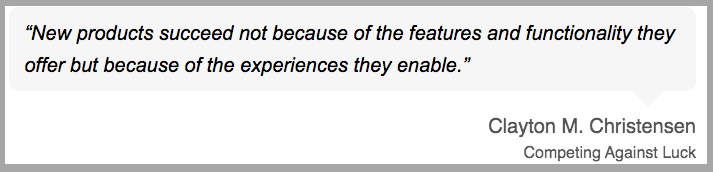
Clayton Christensen, a professor at Harvard Business School, popularized the concept of “jobs to be done” in his 1997 book, The Innovator’s Dilemma.

It popped up as Christensen tried to understand what happened to some successful businesses because they struggled to innovate or to hold onto market leadership.
He realized traditional market research focused on demographics, customer preferences, and product attributes. It still does.
According to Christensen and others, we, as marketers, must understand the underlying motivations and needs that drive customer behavior.
To fill this gap, Christensen developed the theory of “jobs to be done.” Why do customers “hire” or “fire” products and services based on their ability to fulfill specific jobs?
Christensen cited the story of a fast-food restaurant that fought to improve milkshake sales. They had carried out traditional market research and campaigns but had yet to succeed.
Let’s learn more about this from how McDonald’s started their milk shake journey, on the 4Brainru webpage.
“In the JTBD methodology, the example of a milkshake as a breakfast while driving, was used to illustrate this method by the American Harvard professor Clayton Christensen (1952-2020). Thus, McDonald’s quickly caught the trend and demand of consumers, prepared a product corresponding to the mass demand, and made a profit.
According to a study by McDonald’s marketers, drivers buy a milkshake on the way to work, not because of any special taste preferences. All drivers rushing to work in the morning seem to “hire” a milkshake in order to do “certain work in certain circumstances.”
A certain job is to provide a person with breakfast and help him pass the time in traffic.
Certain circumstances – this is actually a morning traffic jam, the need to follow the road, the desire to get your portion of energy, and at the same time not be distracted from driving and not to stain your suit. The McDonald’s milkshake is reliable. it is moderately viscous and moderately nutritious, and as a result, the product fully meets the actual wishes of customers, and therefore is in demand.
There were no special socio-demographic correlations when buying the milkshake: people of all ages drive to work; lawyers, managers, economists and almost everyone have their own car, specially in the United States.
According to Christensen and the Harvard University group of researchers, businesses today focus too much on creating customer profiles and looking for correlations in data.
In order to offer products and services that people really want to buy, a business should focus not so much on personalities and the “customer portrait”, but on the very “work that needs to be done”.
If a product performs well, it is purchased and “hired” again. If not, they “fire” it and look for another one. Thus, Jobs to Be Done is not only a function, it is also a certain background. Therefore, the circumstances in which buyers are willing to purchase a particular product are more important than the characteristics of the buyer.
Is it really so important for a business whether a 20 or 50 year old buys his milkshake, in a Cadillac or Ford car; man or a woman? If early in the morning they all buy the same thing for about the same amount, then socio-demographic characteristics are hardly fundamental here. However, it will still be not so much a specific person as “a certain request in certain circumstances.”
By understanding the job that consumers try to get done, companies can design and market products better.
They have a range of possible solutions available, and they choose the one that offers the best way of accomplishing a job.
This provides a fresh perspective on innovation and marketing beyond traditional research and product-focused approaches.
Invesp is the second consulting company to specialize in conversion rate optimization (CRO) in North America.
Let’s see what they have to say,
“We use the SHIP methodology which is an acronym for Scrutinize, Hypothesize, Implement and Propagate. The #JTBD interviews and analysis process is part of the scrutinize phase. But unlike other conversion research techniques, #JTBD reveals the point that a customer goes through when considering purchasing a product or service.
Knowing that one of our Senior Marketing Strategists – Gulcin – has been involved in a lot of #JTBD analysis, I asked her about the importance of JTBD in CRO projects, and she had this to say:
Job-to-be-done interviews allow you to drill down into the minds of consumers in a way that can’t be done using polls and surveys. You get to know that exact feeling and need that pushed customers into making a purchase. It is those same feelings and needs expressed in sentences and words that we capture and include in Value Propositions.“
Why should you get on the JTBD bandwagon?

Photo by Sevenstorm-Juhaszimrus—Pexel images.
Long-term relevance:
Pain points can be temporary or subject to change based on external factors. JTBD is more enduring and fundamental.
Differentiation and innovation:
Understanding the jobs customers need opens up opportunities for differentiation and innovation. You can develop unique offerings that efficiently address those jobs.
Customer-centricity:
Clayton’s theory places clients at the center of the whole brouhaha. This builds stronger relationships, fosters loyalty, and makes customers happier.
Stable customer focus:
People want one thing today and desire another the next depending on how hot or cold the weather is, or if someone looks at them with a raised eyebrow.
Core jobs remain. This allows businesses to develop long-term strategies and solutions aligned with their client’s needs.
Strategic decision-making:
With this cat in the bag, you, as a marketing specialist, can make strategic decisions for your clients:
- They can divide resources,
- invest in product research or development,
- innovate to align with the fundamental jobs they are trying to do.
This will lead to more sustainable growth and competitive advantages.
Value creation:
Businesses can develop offerings that provide meaningful and lasting value by focusing on jobs rather than transient desires.
Opportunity identification:
As societal needs, technology, or market dynamics evolve, new challenges and problems arise.
Andreas is a five-man business specializing in tourism. He realized he could not keep relying on Google Sheets and email to handle his business because he wanted to grow. He knew of project management software but was reluctant to try it because he thought his business was too small and couldn’t afford the investment.
A friend introduced him to very popular project management software, which he adopted.
And everything changed.
This is what a Job to be Done looks like. A consumer goes along his life as he’s come to know it. Then things change. He is presented with an opportunity for self-betterment — that is, make changes so he can grow. When or if he finds a product that helps him realize that growth opportunity, he can evolve to that better version of himself he had imagined.
Besides demonstrating a JTBD well, Andreas’s story also demonstrates that creating a new me (i.e., having a JTBD) is a process. It’s not something that consumers have; it’s something consumers participate in. That’s why it’s called a Job to be Done. A comparable example is falling in love. Falling in love isn’t something you have; it’s something you participate in.
And just as you can’t complete the fall-in-love process by yourself, a customer can’t complete a JTBD by himself. He needs a product to help him design, construct, and complete it.”
Alan Klement “What are Jobs To Be Done”, Medium October 2016
Let’s recap:
By focusing on core jobs, businesses can maintain a stable customer focus, make strategic decisions, create long-term value, and identify new opportunities for innovation.
Long-term customer satisfaction, loyalty, and repeat business are the cornerstone of JTBD.
Targeting specific jobs and outcomes can disrupt markets and gain a competitive advantage.
Isn’t that cool?
JTBD, together with the Pain Point method, can become valuable tools for businesses seeking to
- Understand their customers better
- Identify opportunities for innovation,
- Design solutions that address customer needs and aspirations.
Uphill battle won.
 The Analytical Wordsmith
Comments
One response to “From Pain Points to Conversions: The Journey with Jobs to be Done”
Good stuff. Check me out for ideas!!
LikeLike