
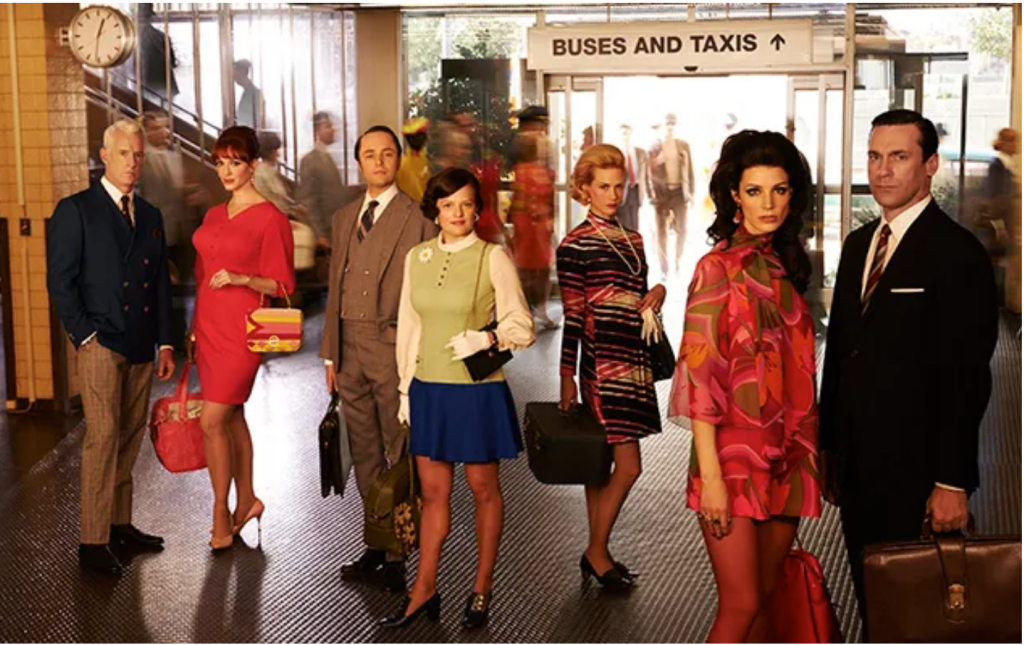
Did you know that copywriting and drama, while in different spaces, share a bond?
A connection that goes as deep as the roots of an oak tree?
Two peas in a pod, tugging at emotions and using triggers to make prospects become customers.
There’s a Mad Men episode in which Don Draper creates a pitch for Kodak that is launching a new product: a slide projector the client had named The Wheel.
It had a circular tray, hence the name, with the capacity to hold 80 slides
The wheel— and I know I’m repeating myself here, turns round with a remote control and shows the images on a screen.
At first, he didn’t understand how to create a campaign for an object he couldn’t connect with. He recruits some of his creatives and fumbles with the assembling of the projector and spends nights in his office.
Until he cracks the code.
Here’s How Copywriting and Drama Are Terrific Partners in Crime.
Act 1: The Hook/Headline – Grabbing Attention
Like in a good play or movie, copywriting has an opening scene in which you must grab the reader’s attention.
It’s the moment that sets the stage for everything to come.
In drama, it’s often a twist, a shocking revelation, or an intriguing character introduction that makes us gasp.
In copywriting, the headline is our stage and must be magnetic. It’s the first emotional spark we pull to engage the audience.
Back to the episode. Don presents the product to the client with a new name and this headline:
THE CAROUSEL. A FAMILY’S JOURNEY THROUGH TIME.
Kodak executives are in.
Act 2: The Rising Action – Building Desire
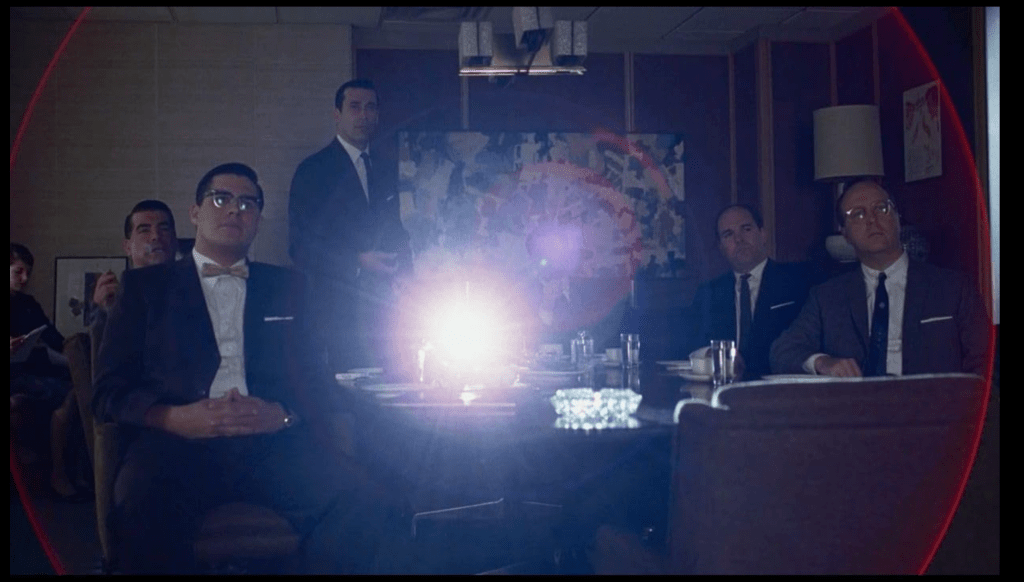
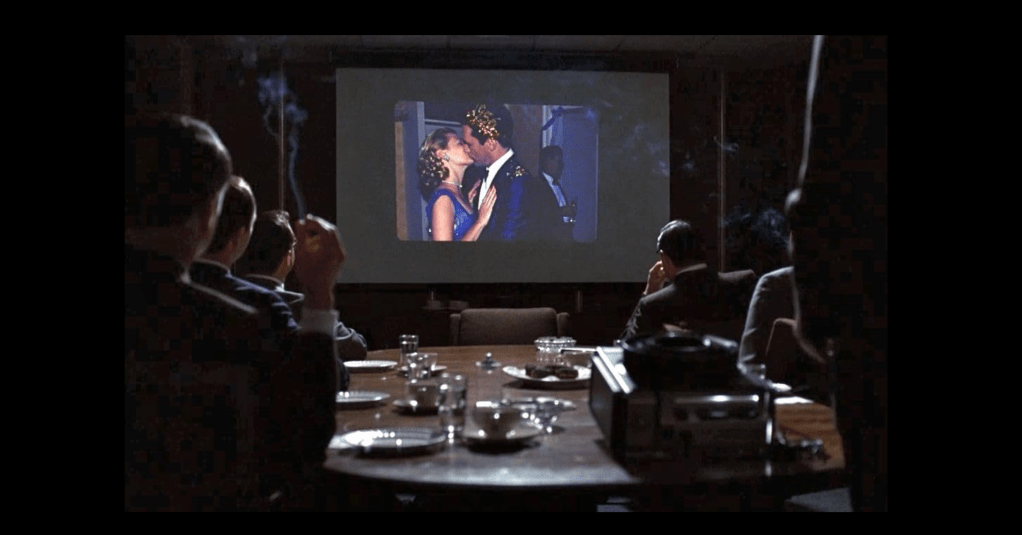
Don turns on the projector and the images show slides from his private life:
The day he married Betsy.
The day his girl was born,
Don asleep on a sofa with both kids lying on his stomach.
The whole family playing in the garden.
Everyone smiling, happy, goofing around.
And he describes The Carousel as the means to
“Travel the way a child travels, around and around and back home again to a place where we know we are loved.”
His voice is soft, deliberate, dreamy.
“Nostalgia: it’s delicate but potent… In Greek, nostalgia literally means the pain from an old wound. It’s a twinge in your heart far more powerful than memory alone.”
“Is there one thing in your life that you would like to remember? One moment that you would like to live over again?
This machine isn’t a spaceship, it’s a time machine. It takes us to a place where we ache to go again.
It lets us travel back to that one little moment that we missed, that we regret.”
You could hear a pin drop in the room.
We see the client can’t speak, looking at the screen and back at Don, who stands in front with a kind smile.
Meanwhile, Harry Crane gets up, choking with emotion.
The pitch spoke to a universal human desire: to hold onto the past.
“Aha!”—the client.
Act 3: The Climax – Presenting the Solution
In both drama and copywriting, the climax is the pivotal moment.
In drama, it’s the scene where the hero faces their ultimate challenge.
In copywriting, it’s the part where you unveil the product or service as the solution to the reader’s problem.
Kodak, had another appointment lined up with another agency.
“Good luck with that next meeting”, said Duck Philips.
Needless to say they never got to second base.
Draper, once again, had hit a home run.
And The Slide Carousel became the hero that resolves the dilemma.
Act 4: Overcoming Objections
After the climax, drama brings the action in which you tie loose ends.
In copywriting, it’s the moment to address potential objections and hesitations.
You need to reassure your audience, building trust and credibility.
Here’s how Don would have tackled objections:
Price:
“The Slide Carousel is worth every penny when you consider the joy it will bring to your family for years to come.”
Bulk:
“The Slide Carousel’s size is part of its charm. It’s a reminder of a simpler time when families gathered around to share stories and memories.”
Lack of innovation:
“The Slide Carousel is more than just a product, it’s an experience. It’s a way to relive happy memories and create new ones with the people you love.”
Obsolescence:
“The Slide Carousel is a way to preserve your family’s memories in a way that can never be lost or corrupted.”
Act 5: – The Happy Ending
Every good story has a satisfying end, and copywriting is no different.
The final curtain in copywriting is your call to action (CTA).
A happy one for both your audience and your brand.
Your CTA could be as simple as
- “Click here to start your transformation journey today” or,
- “Sign up now for exclusive access to our limited-time offer.”
This is where you push your prospect to take the final, decisive action.
Act 6: The Encore – Ongoing Engagement
Drama often leaves us wanting more, and the same holds true for copywriting.
After the initial conversion, can nurture a relationship with your audience.
This could be through follow-up emails, newsletters, or extra content.
Keep your audience invested in your brand.
The Magic of Emotional Triggers in Copywriting
Drama wouldn’t work without emotional prompts.
Copywriting wouldn’t work without them, either.
Here are some:
Fear:
Remember the classic horror movie tactic? In copywriting, you can use fear to highlight the consequences of not taking action.
Hope:
Or how Don Draper said: “Advertising is not just about selling products. It’s about selling dreams. It’s about giving people hope.”
Curiosity:
Drama often thrives on unanswered questions.
In copywriting, you can build up interest with statements like:
“The one thing successful people do different…”
Empathy:
Drama connects us to characters on an emotional level. In copywriting, you can empathize with the prospect’s thoughts.
In his book To Sell is Human, Daniel Pink says that to be persuasive, you have to get into the prospect’s mind.
That can be only done through attunement and empathy.
Empathy is about understanding the other person’s emotions.
Attunement is about understanding the other person’s state of mind.
Author J. K. Rowling uses empathy and attunement in Harry Potter to make the audience feel part of the story. We experience the characters’ magic world through their eyes.
They are essential in creating an affinity with the audience and making the drama feel real and relatable.
As a marketer, you need to create that kind of connection with your client, and using both skills will take you a long way in this endeavor.
Fade to black
Copywriting is a form of storytelling, and storytelling is at the heart of all drama.
The moment that you understand the parallels between these two worlds is the moment when you’ll write content that strikes a cord with your audience.
One that gets you to – the click, the sale, or the action you’ve orchestrated.
May your words have the power to touch the lives of others and leave a lasting impression that inspires.
Here’s to a standing ovation.
Bravo!
 The Analytical Wordsmith